Modernism’s most copied armchair is not really an armchair. It is an argument about what a club chair had been hiding all along.

Look at an LC2 for long enough and you realise you are looking at an X-ray.
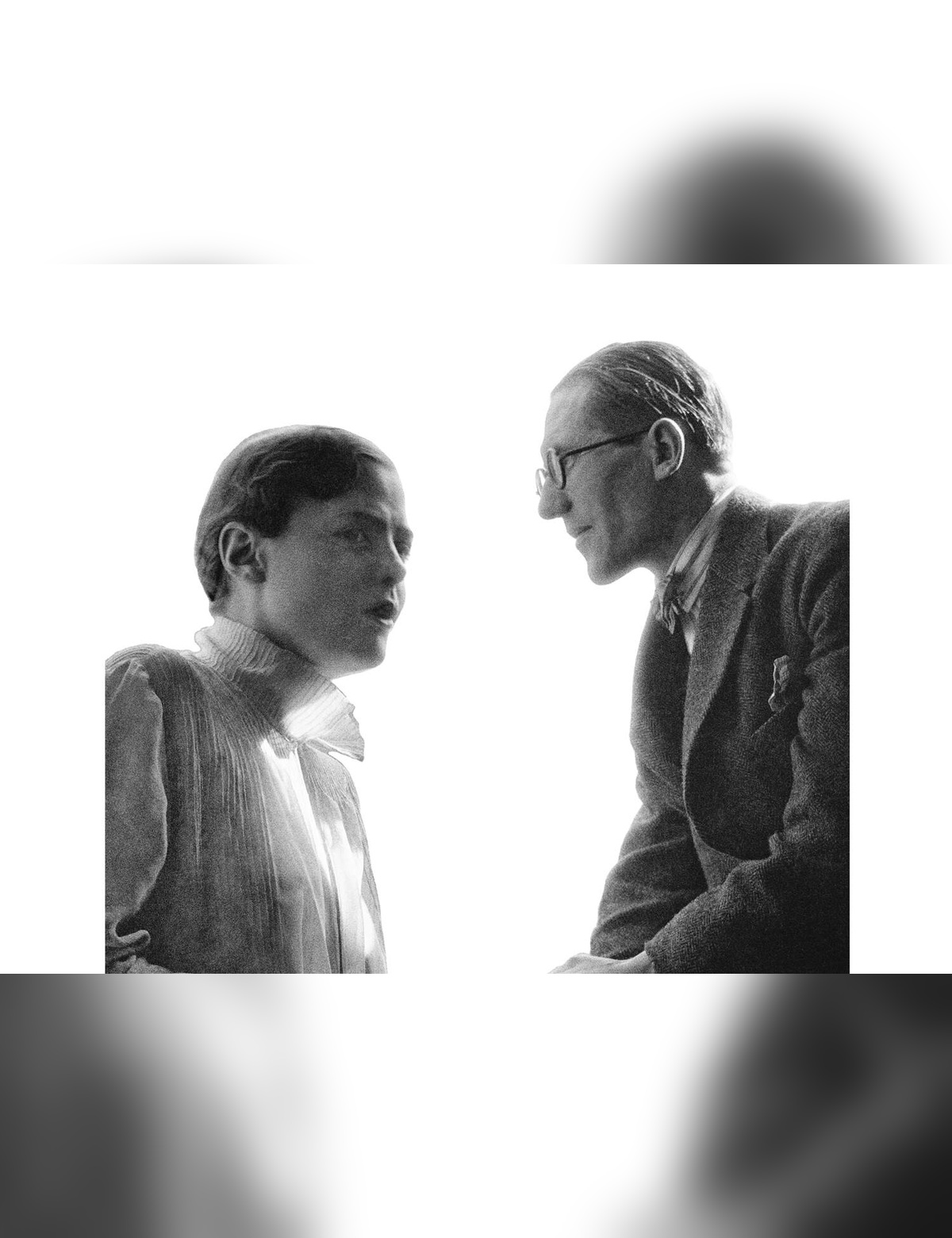
Every club chair before it had a skeleton. A hardwood frame, webbing, springs, the carpentry that actually held the sitter up. And every upholsterer in Europe had spent two centuries burying that skeleton under horsehair, velvet and buttoned leather, because structure was considered a private matter. A gentleman’s chair did not show its bones. In 1928, in the studio at 35 rue de Sèvres in Paris, Le Corbusier, Pierre Jeanneret and Charlotte Perriand performed the rudest act in the history of upholstery. They pulled the skeleton out of the club chair, straightened it into a cage of tubular steel, polished it until it shone, and hung it on the outside. The cushions, suddenly homeless, became five loose leather volumes that simply sit inside the frame like cargo. Then they named it with a straight face: Fauteuil Grand Confort. The great comfort armchair. It was a provocation dressed as furniture. It is also, a century on, one of the most copied objects on earth, which is why it deserves to be looked at slowly.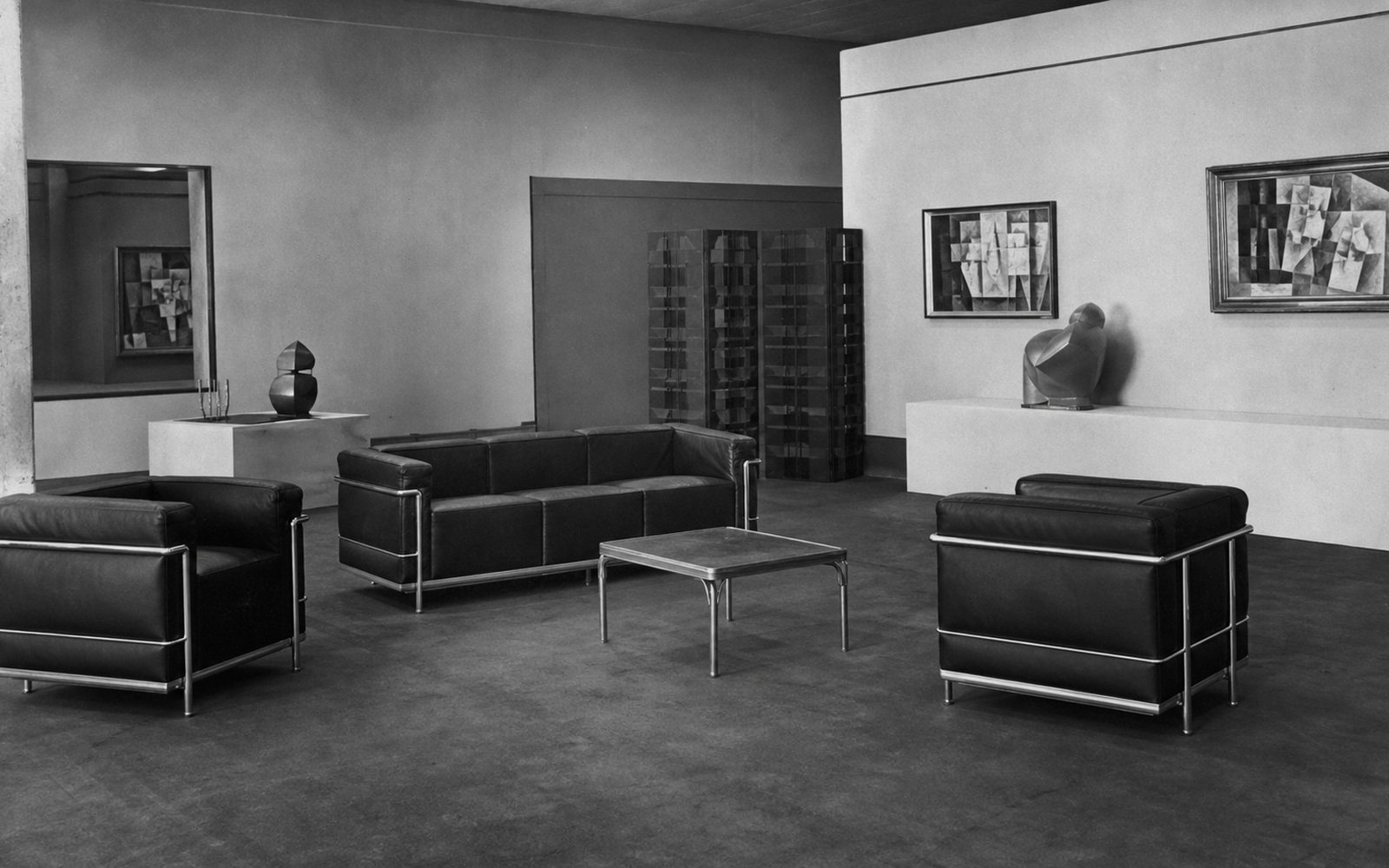
Five cushions and a cage: how the LC2 Grand Confort works
The LC2 is the compact model, the petit modele, of the Grand Confort idea; its wider, deeper sibling became the LC3, and the full family story is told in our LC collection pillar essay. What makes the small one so potent is its geometry. It is very nearly a cube. Seat, back and arm cushions are all fat rectangular blocks of near identical logic, and the steel frame traces the edges of the cube like a drawing in the air. Nothing overlaps. Nothing is blended. The frame does all the holding, the cushions do all the yielding, and the eye can always tell which is which. That one decision, the strict visible separation between structure and softness, is the entire design. The chair does not hide how it works, it performs how it works. The studio called this kind of furniture equipment, not decoration. A chair, in their thinking, was an instrument the way a car or a typewriter was an instrument, and pretending otherwise was sentimentality. Perriand, who had joined the studio in 1927 after Le Corbusier first waved her away with “We don’t embroider cushions here,” brought the crucial ingredient: the body. She understood that sitting composed, sitting to talk, sitting to withdraw, are different acts. The LC2 is calibrated for the composed version, upright enough for conversation, soft enough to forgive a long one.“The chair does not hide how it works, it performs how it works.”
What it did to the room
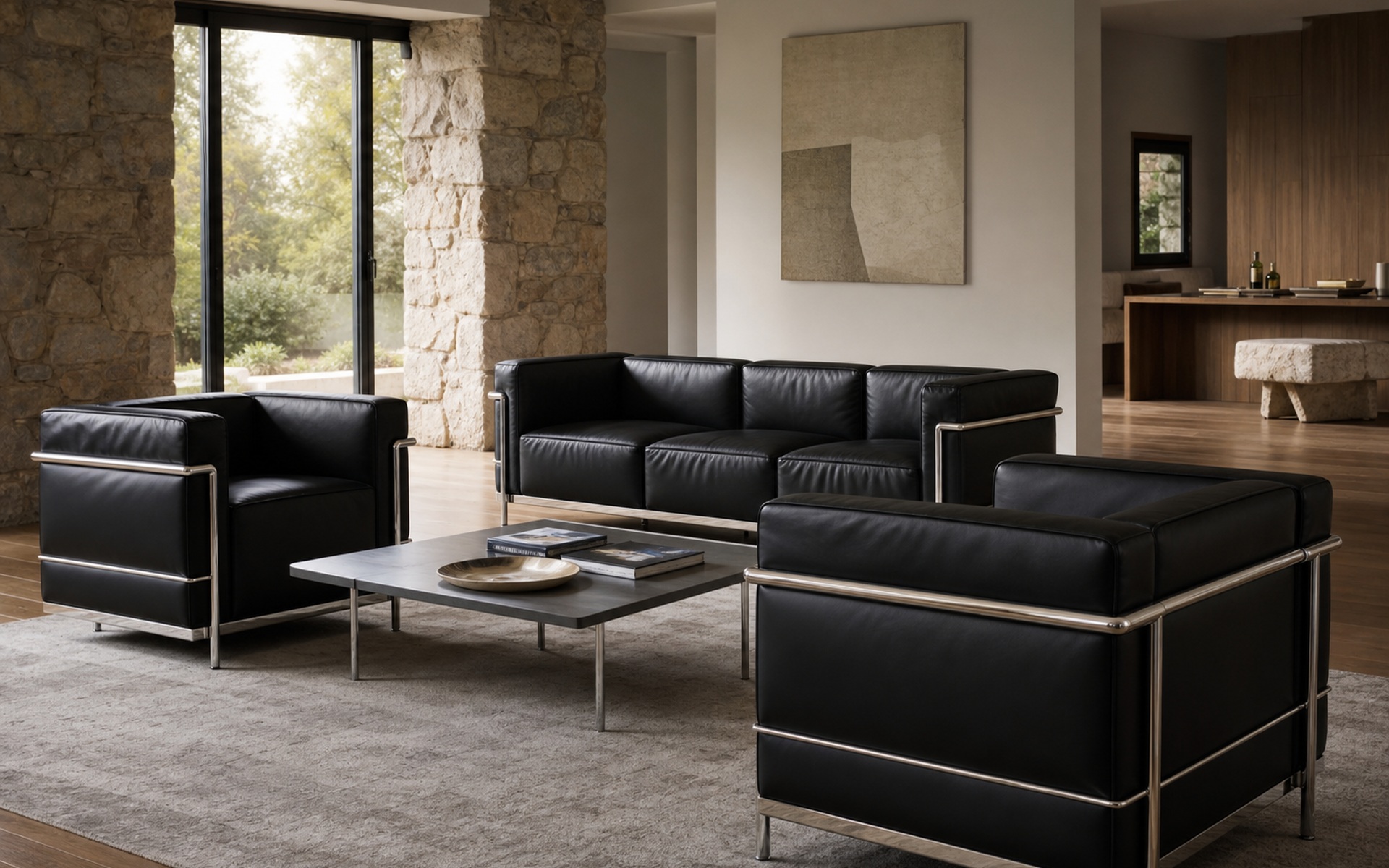
Drop an LC2 into a room and the room changes register. Because the object is low, square and self-contained, it does not sprawl or lean on the architecture. It sits in space the way a good sculpture does, complete from every angle, which is why architects have loved it for a hundred years and why it so often stands in pairs, facing each other across a rug like chess pieces. In 1929, when the studio showed its furniture at the Salon d’Automne as “equipment for the home,” that self-contained quality read as cold. Critics saw laboratory apparatus. The pieces were awkward and expensive for Thonet to produce in the early 1930s and the experiment went quiet for a generation. It took Cassina’s 1965 revival, made with the designers’ blessing, to turn the manifesto into a modern classic, and each authentic piece today carries all three names: Le Corbusier, Pierre Jeanneret, Charlotte Perriand.The honest knock
Here is the fair criticism, and it should be said plainly: the Grand Confort is not the most comfortable chair you will ever sit in. It holds you at one excellent, composed angle and offers nothing else. The cushions must be kept plump and squared or the whole geometry slumps; leather is cold for the first half minute in winter; and nobody has ever spent a rainy Sunday curled up in one. Forty years later, designers like Michel Ducaroy answered it directly with the frameless, slouching Togo, which is what happens when comfort finally wins the argument against structure. Both positions are honourable. Only one of them lets you nap.Why the copies always give themselves away
The LC2 may be the most knocked-off armchair in existence, and the knock-offs are a free education in why the original matters. Watch for the tells. The tube diameter drifts thin, so the frame reads as wire rather than structure. The bend radius at the corners goes slack. The cushions lose thickness and internal tension, so instead of five crisp volumes held in a cage you get ordinary squashy upholstery leaning on a chrome rail. Seat height creeps up or down. And the cushions get lashed tight to the frame, erasing the one line the whole design exists to draw. A bad LC2 copy gives you chrome and black leather. The original gives you a philosophy of where the body ends and the structure begins. That philosophy is the product. The leather is just the packaging. A century after three designers pulled the skeleton out of the club chair, the strange cube from the rue de Sèvres still does what it was built to do. It equips a room, composes a sitter, and quietly asks every fat upholstered chair in the building what, exactly, it is hiding.
Sources and confidence
- LC collection history, the 1929 Salon d’Automne presentation and Cassina production from 1965, Cassina. Verified. cassina.com
- Grand Confort designed 1928, credited to Le Corbusier, Pierre Jeanneret and Charlotte Perriand; LC4 sibling piece in MoMA collection. Verified. moma.org
- Perriand’s 1927 hiring and the “We don’t embroider cushions here” story, Design Museum, London. Verified, as told in Perriand’s memoir. designmuseum.org
- Early Thonet production and small pre-war numbers. Probable, widely reported in design histories. wikipedia.org

